



From Nottinghamshire Roots to West End Spotlight: Lyn Gardner Interviews Beth Steel
How Till the Stars Come Down blends humour, family drama, and cultural truth — and why playwright Beth Steel never expected her deeply local story to resonate worldwide.

Shortly before Beth Steel’s play Till the Stars Come Down opened at the National Theatre in early 2024, the playwright had a meeting with the NT’s then artistic director, Rufus Norris. Norris was very keen that the marketing copy for the upcoming play lean into its humour. Steel looked him in the eye and declared confidently, “Oh no, Rufus, no one’s going to laugh.”
It turns out that Norris was dead right and the playwright was dead wrong. Till the Stars Come Down, which opens at the Theatre Royal Haymarket on July 1st, is a riotously funny but also painfully truthful play set in Mansfield in Nottinghamshire, just a stone’s throw from the town where Steel was raised and where her father worked down the pits. Until he couldn’t because they had all closed down.
Nottingham’s pits have been shut for a quarter of a century, but as Steel’s play demonstrates, the loss is still felt by many, and it haunts her sizzling family drama which is set during the wedding of Sylvia, a former miner’s daughter, to Marek, a young man who is part of a growing Polish community in the area. It’s a play, which, as James Baldwin once said, reminds us that “history is not the past but the present. We carry our history with us.” Right into the future: Sylvia and Marek are on the cusp of change, but so too is the place where they live. Can these two futures be reconciled?
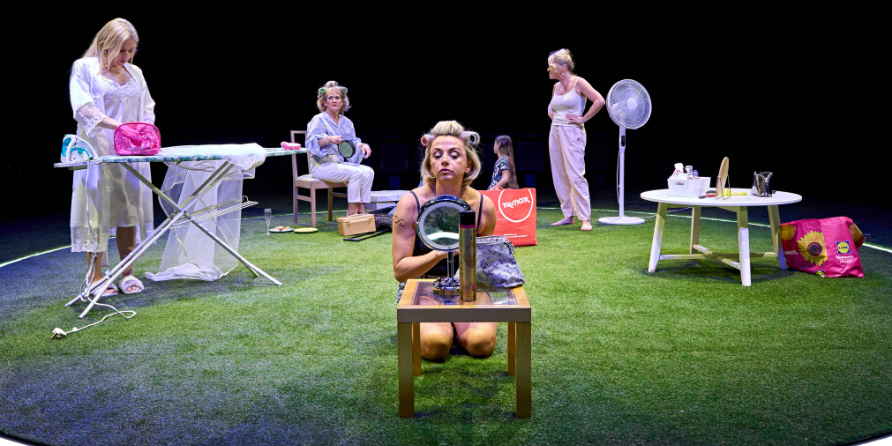 Till the Stars Come Down at the National Theatre. Photo by Manuel Harlan.
Was Steel surprised or upset when audiences at the National clearly found the play hilarious? “I was a bit shocked as to just how funny audiences found it,” she admits, but points to the fact that there is a fine line between “crying with laughter and tiddling your own pants”. She references the work of painter Francis Bacon, whose blurred imagery creates an unsettling sense of people in motion or moments of transformation. Till the Stars Come Down does indeed have that quality too, as well as a touch of Chekhovian melancholy humming beneath the mirth.
“It’s a very passionate play,” says Steel. “It’s about people living with a certain level of flammability. Fire runs through the play.” It does, and it doesn’t take long for things to ignite as resentments, secrets, relationships and insecurities surface and everybody has to reassess how to carry on.
For Steel, the West End transfer is all the more delicious because she never expected it for her work. “I felt that because I write about where I’m from and it is so culturally specific that it would never get a commercial offer. I was absolutely fine with that, because as a writer you have to make the work you want to make, and I’ve been lucky and worked in some incredible spaces. So, it wasn’t on the wish list for the fairy to come and tap me on the shoulder. But now it’s happened, it feels extraordinary.”
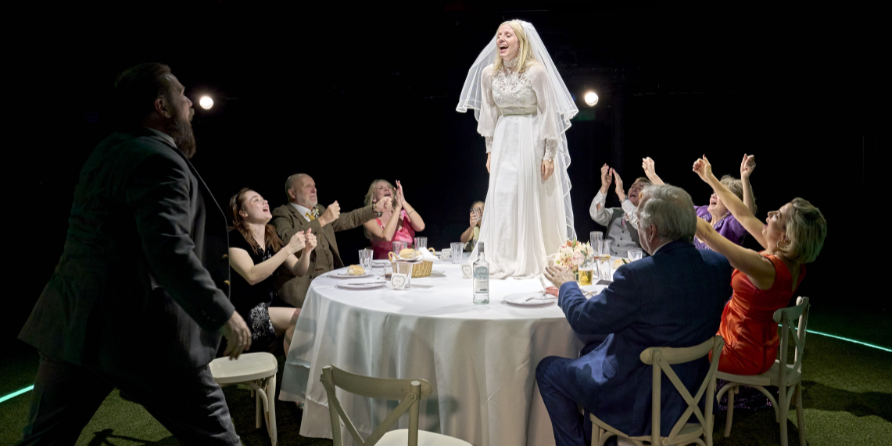 Till the Stars Come Down at the National Theatre. Photo by Manuel Harlan.
It’s not just the West End which has come calling. When we speak, Steel has recently returned from Japan, where Till the Stars Come Down has opened in Tokyo. Again, she never anticipated that her work would travel internationally because it is culturally specific and tends to have large casts. Stars comes with a cast of 10, including a child. A big ask for any theatre. In any country.
But she points to the fact that while Stars may be set in Mansfield, weddings are universal across the world. As too are families. Every family, whatever their social class, has its own version of Aunty Carol, just one of the many larger-than-life characters which make Stars such a joy.
“Nobody has ever come up to me and said, ‘I don’t recognise this family,’” says Steel. Not in London nor Japan, where the play had a huge reception in a production which stayed true to the drama’s Nottinghamshire roots. “The jokes about Kilroy and crumpets are all in there, and sitting in Tokyo and listening to the incantation of Nottinghamshire pit villages was like hearing a spell.”
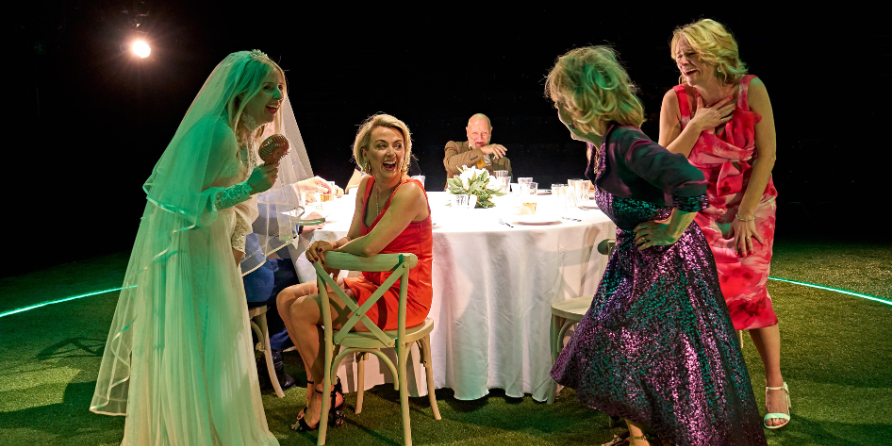 Till the Stars Come Down at the National Theatre. Photo by Manuel Harlan.
If state of the nation plays are supposed to be deadly serious, Stars bucks the trend and reminds us that Steel is not only that rare thing in British theatre—a genuinely working-class voice—but one who has grown with every play she writes.
She’s often had to fight to get attention—many theatres simply passed on her second play, Wonderland, without even reading it, until director Ian Rickson gave it a recommendation and Hampstead Theatre staged it. It’s been a slow but steady journey for Steel to this moment of success, but although it has often been hard, she’s not sorry that she didn’t find overnight success with her first play, Ditch, at the Old Vic Tunnels 15 years ago.
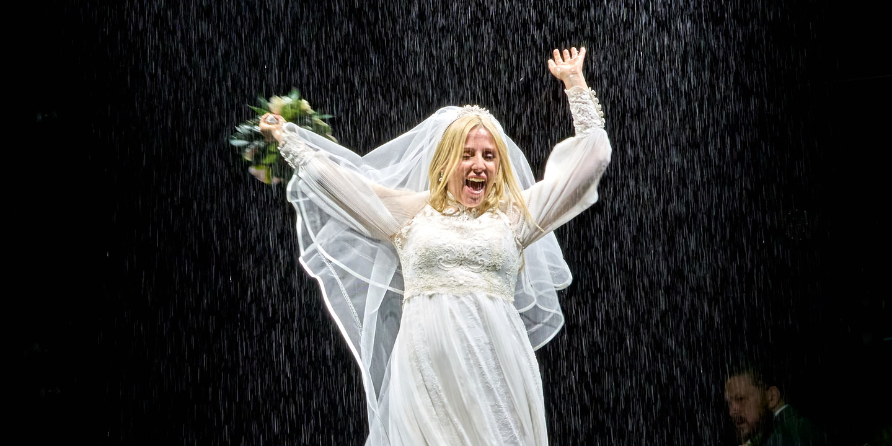 Till the Stars Come Down at the National Theatre. Photo by Manuel Harlan.
“When you have success, it doesn’t make writing the next play any easier, and that is even harder if you have a big success with your first play. At that stage you haven’t even found out who you are as a writer, and people have already decided what kind of writer you are for you. That must be really paralysing.”
So, for Steel, it is business as usual even as the West End beckons and Stars is back in rehearsal. “I’m back at my desk in my jogging bottoms with my laptop writing the next play and working it through.” Slowly. Expertly. Carefully. Like a surgeon manipulating a bone, until-- like Stars – she’s set it just right.
Cover photo from Till the Stars Come Down, playing at the Theatre Royal Haymarket from Tue 1 Jul - Sat 27 Sep. Book your tickets via our website or app.


